
Low Flow Meter Compliance: ATEX Zones, 100 bar, 316L
A low flow meter entering a hazardous area or a high-pressure line is not released against one certificate. It is released against a pack of documents that must agree with each other and with the meter actually ordered: the ATEX certificate and the zone it records, the CE certificate and the standard it cites, the quality management certificate, the pressure rating on the datasheet, the material grade of the wetted parts, and the process connection written on the order.
When one link is missing, a fully functional instrument can still fail acceptance at the goods-inward gate. The most common gaps are not fraudulent documents; they are mismatches. A certificate covers five models and the file contains one page. A valve line is Zone 1 and the certificate records Zone 2. A datasheet offers 30 bar or 100 bar and the order confirmation names neither. A material line reads “stainless steel” when the application required 316L.
This guide is written for the procurement engineer and the QA reviewer who have to close those gaps. It explains what the ATEX approval covers on the micro Coriolis and steam mass flow meter lines from Silver Automation Instruments — a Chinese manufacturer of flow, pressure and level instrumentation founded in 2010, whose low flow range includes the SH-CMF-FE micro Coriolis mass flow meter, the SH-CM Coriolis mass flow meter, the STLU-VFN steam mass flow meter, the SRK-DL low flow thermal mass flow meter and the SRK-100 thermal mass flow meter — how a 30 bar or 100 bar rating changes the review scope, and why 304 versus 316L changes what you must trace. It stays procedural: which documents to request, how to reconcile them with the stated process connections, and what to check before you sign.
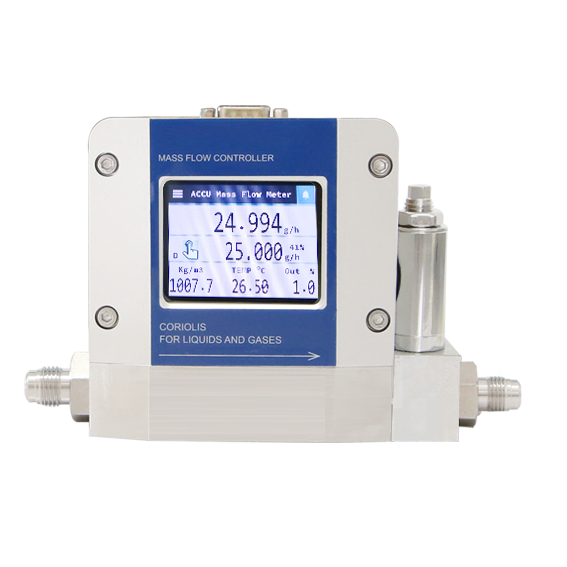
What a compliant low flow meter documentation pack must contain
A documentation pack is the set of records that lets a third party confirm, without contacting the supplier, that the delivered instrument is the instrument that was approved for the duty. It has four layers, and they answer four different questions.
- Hazardous-area layer (ATEX): may this model be installed in this classified area, and under which certificate and standard?
- Electromagnetic conformity layer (CE): against which standard was the flow meter declared for the EU market, and is that declaration still valid?
- Management-system layer (ISO 9001): was the unit produced under a certified quality management system, and is that certificate current?
- Order-specific layer (datasheet and order confirmation): which pressure rating, which material grade, which process connection, and which calibration or inspection record accompanies this serial number?
The first three layers are certificates held at company or product-line level. The fourth is the only layer that is specific to your order, and it is the layer most often left incomplete because it has no official-looking seal. A pack without it cannot be reconciled.
Why documentation review has become a longer step than the specification review
The commercial weight behind this work is easy to see in the market data. Grand View Research valued the global flow meter market at USD 10.64 billion in 2024, with Europe holding the largest regional share at over 35% — a region where the CE and ATEX paper trail is a routine procurement gate rather than an exception. The same source expects the 2-inch and smaller pipe size segment to grow fastest through 2030, driven by pharmaceuticals and food and beverage, which is precisely the segment where sanitary connections and material traceability dominate acceptance.
Technology choice matters too. Fortune Business Insights recorded Coriolis meters at 26.77% of the intelligent flow meter market in 2026, and Coriolis is the technology that carries the multi-parameter expectations — mass flow, density, temperature — that a QA reviewer has to see reflected in the datasheet rather than inferred from a brochure. P&S Intelligence sized the global microfluidic devices market, which includes micro flow sensors, at USD 22.1 billion in 2024. More small-line, high-value installations mean more orders where a single missing record holds up commissioning.
None of that data tells you whether a specific meter is compliant. It only explains why the review is worth running properly.
Layer one and two: the CE certificate and the ISO 9001 certificate
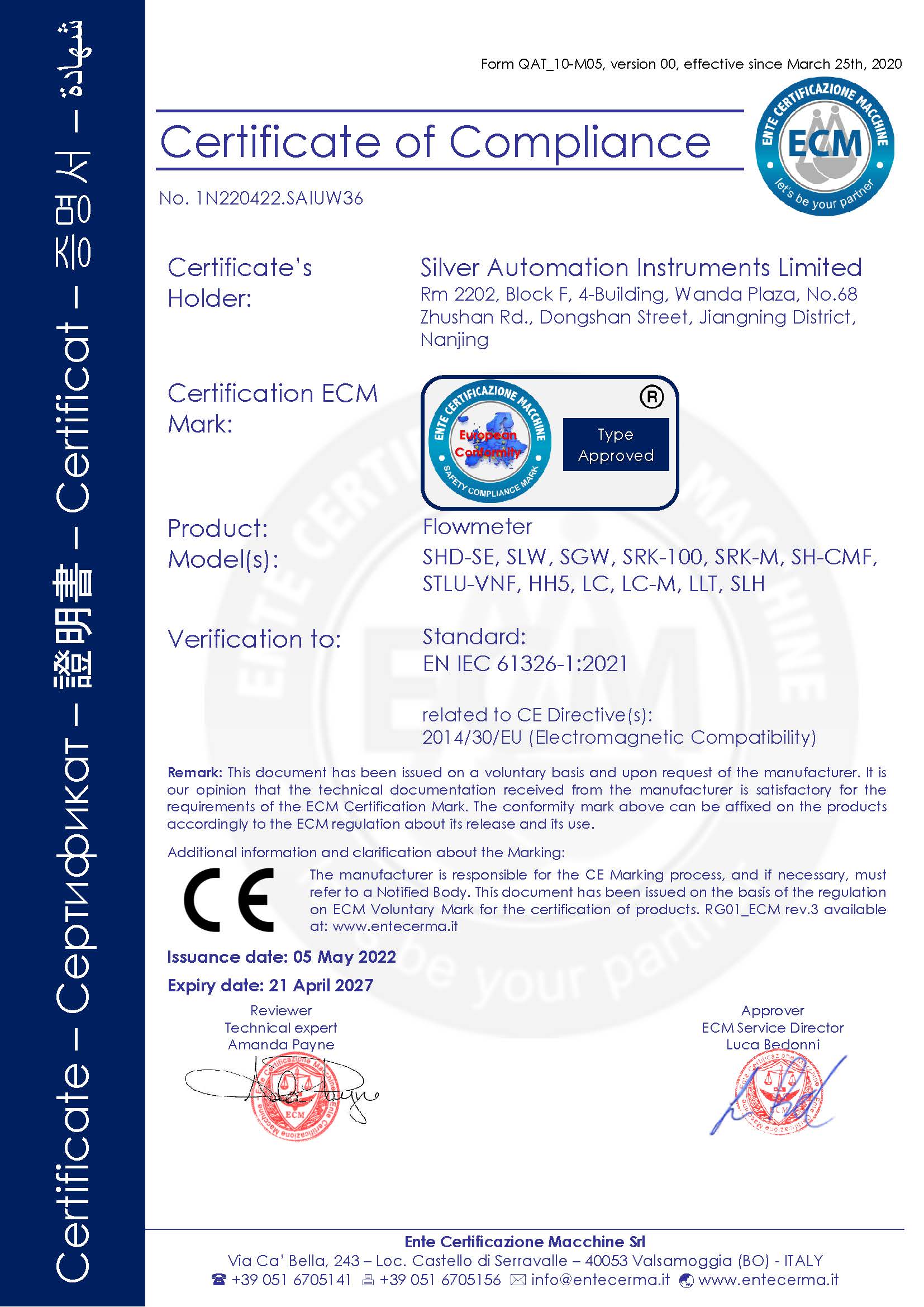
Silver Automation Instruments holds a CE certificate numbered 1N220422.SAIUW36, issued by Ente Certificazione Macchine Srl on 5 May 2022 and valid until 21 April 2027. The certificate applies to the EU market, records its scope as “Flow meter”, and cites the standard EN IEC 61326-1:2021. The related product list covers the SH-CMF-FE, STLU-VFN, SRK-DL, SRK-100 and SH-CM.
Two review points follow. First, the CE certificate evidences conformity to the EMC standard it cites; it is not the hazardous-area document. ATEX is a separate certificate with a different number, a different issuing body and a different validity window, and a buyer who files only the CE certificate has not addressed explosion protection at all. Second, check the expiry date against the commissioning date, not the order date. A project that commissions after 21 April 2027 needs either a renewed CE certificate or written confirmation from the supplier before the pack is closed.
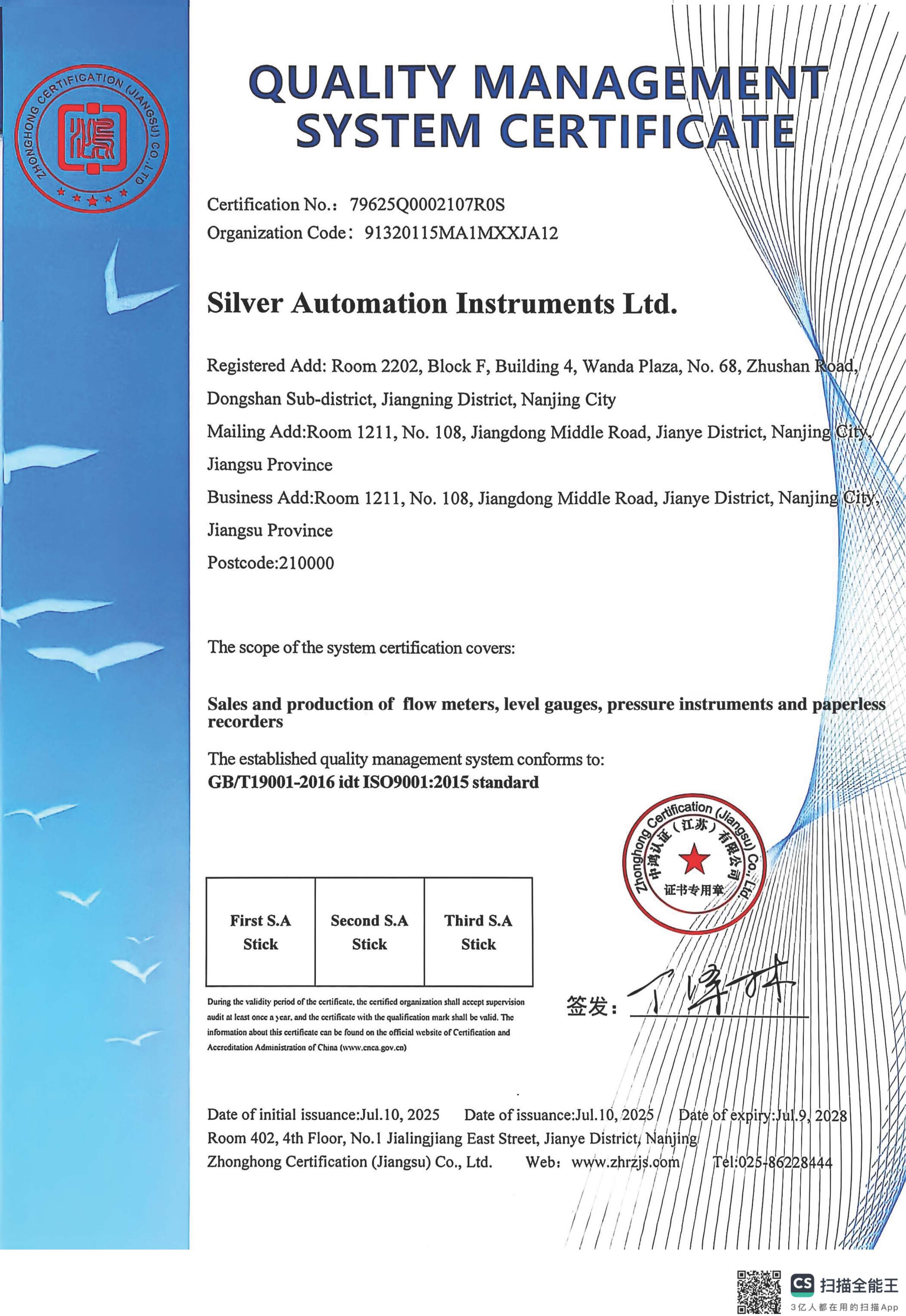
The quality management layer is certificate 79625Q0002107R0S, issued by ZHONGHONG CERTIFICATION (JIANGSU) CO.,Ltd against ISO 9001:2015, issued 10 July 2025 and valid until 9 July 2028, with the scope recorded as a quality management system certificate. Read it for what it is: it certifies the system under which the meter was built, not the performance of the individual unit. No certificate in this layer replaces the calibration or inspection record for the serial number you receive.
What ATEX approval covers on the micro Coriolis and steam mass flow meter lines
Two ATEX certificates sit behind the low flow range, and they do not have the same coverage. This is the single most useful fact in the whole pack.
Certificate ICR/VC/HM251296, issued by ICR, was issued on 9 December 2025 and is valid until 9 December 2030. It records a scope of Zone 2 and cites IEC 60079-0:2018+A11:2024, EN 60079-1:2014+A11:2024 and EN IEC 60079-31:2024. Its related product list covers all five models: SH-CMF-FE, STLU-VFN, SRK-DL, SRK-100 and SH-CM.
Certificate ECM 22 ATEX-B 0S05, issued by Ente Certificazione Maccine srl, was issued on 21 February 2022 and is valid until 20 February 2027. It also records a scope of Zone 2 and cites EN IEC 60079-0:2018/AC:2020, EN 60079-1:2014 and EN 60079-31:2014. Its related product list is narrower: the SH-CM Coriolis mass flow meter and the SRK-100 thermal mass flow meter only.
| Model | ATEX certificate(s) on file | Recorded zone scope | Standard cited at model level |
|---|---|---|---|
| SH-CMF-FE micro Coriolis | ICR/VC/HM251296 | Zone 2 | EN 60079-1:2014+A11:2024 |
| STLU-VFN steam mass flow meter | ICR/VC/HM251296 | Zone 2 | IEC 60079-0:2018+A11:2024 |
| SRK-DL low flow thermal | ICR/VC/HM251296 | Zone 2 | EN IEC 60079-31:2024 |
| SRK-100 thermal mass flow meter | ICR/VC/HM251296 and ECM 22 ATEX-B 0S05 | Zone 2 | EN IEC 60079-0:2018/AC:2020 |
| SH-CM Coriolis mass flow meter | ICR/VC/HM251296 and ECM 22 ATEX-B 0S05 | Zone 2 | ICR/VC/HM251296 |
The table above uses the standard cited in the model-level ATEX statement; the certificates themselves carry the full standard sets listed in the paragraphs above. Read it as a routing map, not a substitute for the certificate pages. Three consequences follow for a documentation pack.
The zone scope is Zone 2, and that is a boundary
Both certificates record Zone 2. If the installation drawing classifies the meter location as Zone 1 or Zone 0, the certificates as supplied do not cover that location, and the question must go back to the supplier before the purchase order is released. This is not a documentation technicality; it is the difference between an accepted and a rejected installation. Write the site's classification on the schedule and compare it to the recorded scope on the certificate page — not to the word “ATEX” in a brochure.
Two certificates with different expiry dates mean two checks
For the SH-CM and the SRK-100, both certificates should be in the file, because the older ECM certificate reaches its expiry on 20 February 2027 while the ICR certificate runs to 9 December 2030. A project commissioning in 2027 or later needs the renewal position stated in writing for the older document, or the pack should be built on the certificate that is still valid and that names the model. For the SH-CMF-FE, STLU-VFN and SRK-DL, the ICR certificate is the one that names the model; an ECM page alone will not map to those instruments.
An ingress-protection rating is not a hazardous-area certificate
The SH-CM Coriolis mass flow meter carries an IP65 protection level. IP65 describes ingress protection of the enclosure. It is not a zone classification and cannot be used to argue that a meter is suitable for a classified area. Keep the two attributes on separate lines of the review sheet so that neither is used as evidence for the other.
30 bar versus 100 bar: how the rating changes the review scope
The SH-CMF-FE datasheet lists a pressure rating of 30 bar or 100 bar. That phrasing is the review trigger: the rating is an order-level selection on one model, not a fixed attribute of the product line, and the documentation pack must state which of the two was ordered.
The ATEX certificate does not settle that question. Its recorded scope is Zone 2, and it cites IEC and EN 60079-series standards for explosion protection. It does not state a pressure rating for the meter. Pressure evidence therefore has to come from the order-specific layer, which is why a pack containing only certificates is incomplete for any pressurised line.
What the 30 bar review usually contains
At the lower rating, the review tends to sit on hazardous-area coverage, material grade and the process connection: does the zone scope match, is the wetted-part grade the one the process requires, and does the connection named on the order confirmation match the line schedule? Those three checks can normally be closed from the certificate set plus the datasheet.
What changes at 100 bar
Moving to 100 bar widens the scope in four practical ways.
- Rating confirmation becomes a document, not an assumption. Ask for the order confirmation and datasheet to state 100 bar explicitly, and file them beside the certificates. “30 bar or 100 bar” on a catalogue page proves that both options exist; it does not prove which one you bought.
- Pressure-related records must be requested by name. The supplier should state, in writing, which pressure-related records accompany the ordered rating. Do not infer the existence of a record from the fact that a high rating is offered.
- The connection and joint become part of the pressure review. A flange, wafer, screw or tri-clamp joint carries its own rating, and it has to be at least the ordered meter rating for the line to be coherent.
- The material statement must apply to the same configuration. Confirm that the 316L statement covers the configuration that carries the 100 bar rating, not a different build in the same catalogue family.
Model boundary worth keeping visible: the SH-CM Coriolis mass flow meter has a documented field case of nitrogen gas measured at around 700 bar at a customer site in Chile, with one unit in service for more than three years. That is a case record for the SH-CM, whose high-pressure design is described as capable of withstanding 700 bar or higher. It is not a rating for the SH-CMF-FE, and it should never be copied across to a micro Coriolis review sheet. Pressure capability in this family is model-specific.
Temperature follows the same rule and is reviewed on its own line. The SH-CM Coriolis covers a fluid temperature range of –200 to 350 °C, the STLU-VFN steam meter states a maximum steam temperature of 500 °C, and the SRK-100 states a gas temperature range of –20 to 300 °C. None of those figures is proved by an ATEX certificate, and none should be carried over from one model to another.
304 versus 316L: what material traceability actually requires
Material grade is the quietest failure point in a compliance pack, because “stainless steel” reads like an answer. Across the five models the specified materials are not the same.
| Model | Material as specified | Review note |
|---|---|---|
| SH-CMF-FE micro Coriolis | Stainless steel 316L | 316L stated for the micro Coriolis line |
| SH-CM Coriolis | Stainless steel 316L | Stated as suitable for corrosive chemical applications |
| STLU-VFN steam meter | Flow sensor stainless steel 304; product material 304 or 316 | Two statements — identify which applies to the ordered build |
| SRK-100 thermal | Stainless steel 304 | Grade fixed at 304 |
| SRK-DL low flow thermal | Stainless steel | Grade not stated in the specification — record the supplied grade in the pack |
Two metallurgical facts explain why buyers treat this line seriously. 316L is the low-carbon variant of 316 stainless steel, and the lower carbon content is the reason it is specified where welded wetted parts must retain corrosion resistance through the heat-affected zone. Separately, 316 contains molybdenum, which is why it is chosen over 304 where chlorides or more aggressive chemistry are present. Neither fact makes 316L universally better; it makes the grade decision something the pack must record accurately rather than average out.
A five-step traceability check
- Separate wetted from non-wetted. A product-level material statement covers the instrument; the process review needs the parts that touch the fluid.
- Get the statement per part, not per product. On the STLU-VFN, the flow sensor is stated as stainless steel 304 while the product material is stated as 304 or 316. A pack that says only “stainless steel” has not answered the question.
- Record the grade actually supplied where the specification is open. The SRK-DL specification states stainless steel without naming a grade; the pack should carry the grade that was shipped.
- Match the grade on the material record to the grade on the datasheet. 304, 316 and 316L are three different grades. A pack that mixes them is not traceable, even if every individual page is genuine.
- Anchor corrosive service on the 316L statement. Where the application is corrosive chemical duty, the 316L statement for the SH-CMF-FE or SH-CM is the line the rest of the pack should be reconciled against, and it should name the model and the configuration ordered.
Reconciling certificates with flanges, wafers, screws and tri-clamp connections
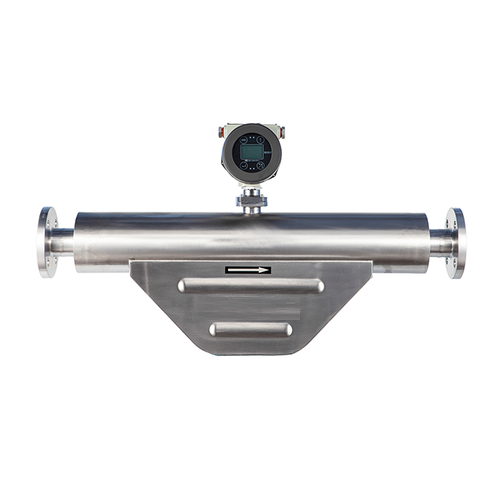
The STLU-VFN steam mass flow meter is documented with process connections in flanges, wafers, screws or tri-clamp. That sentence is where most reconciliation work happens, because certificates are written at model level while connections are chosen at order level. No certificate in the pack names a connection type, so the mapping has to be built by you.
The practical device is a line-item schedule. One row per installed meter, carrying: tag number, model, ordered pressure rating, ordered connection, stated material grade, site zone classification, ATEX certificate number and its expiry, CE certificate number and its expiry, and the calibration or inspection record reference. Every document in the pack is then attached to a row. A page that cannot be attached to a row is either a page for a different order or an unnecessary page — both are findings.
What each connection type adds to the check
- Tri-clamp: typically a sanitary joint in food, beverage and bioprocess lines. The ATEX position does not change, but the material statement becomes the dominant item, and the joint hardware itself should appear on the schedule rather than being assumed.
- Flanged: the flange rating has to be at least the ordered meter rating. At 100 bar this is where the pressure review widens; the meter certificate will not tell you the flange class.
- Wafer: compact installation between flanges. Confirm that the certificate and model designation on the order confirmation still name the same meter, since wafer builds are often specified late in the project and substituted quickly.
- Screw: common on small lines. Confirm the thread specification on the order confirmation against the line schedule; a thread mismatch is an installation failure that no certificate will flag.
One rule prevents most errors: never infer a connection from a product photograph or a brochure rendering. The order confirmation is the reference, and the schedule is where it is proved.
Step-by-step: assembling and signing off the pack
- Freeze the line data first. Model, pressure rating, connection, material grade, site zone classification, fluid and temperature range. Do this before requesting documents so that the request is specific.
- Request the certificate set. For each certificate, record the number, the issuing body, the standard cited, the issue date and the expiry date. Those five fields are what a reviewer actually checks.
- Map every certificate to a model. Use the routing table above. Note explicitly which models carry two ATEX certificates and which carry one.
- Run the zone gap check. Compare the recorded Zone 2 scope to the site classification. If the site is Zone 1 or Zone 0, stop and escalate before the order is released.
- Check validity against the commissioning date. The ECM ATEX certificate runs to 20 February 2027, the CE certificate to 21 April 2027, the ISO 9001 certificate to 9 July 2028 and the ICR ATEX certificate to 9 December 2030. A pack that is valid today can be out of date at handover.
- Reconcile the pressure rating. Confirm that the order confirmation and datasheet both state the ordered rating, and record in writing which pressure-related records the supplier will provide for that rating.
- Reconcile the material grade per wetted part. Close the 304 versus 316 versus 316L question on paper, including the models whose specification leaves the grade open.
- Build the connection schedule. Attach the certificates to rows, not to folders, and check that each connection type has its own joint and rating entry.
- Sign off on identity, not volume. The final check is that the model designation on the certificate, on the order confirmation and on the datasheet are identical strings. A pack with fifty pages that cannot prove that one point is not complete.
Where the pack is tested in practice
Chemical and petrochemical dosing. Corrosive media make the 316L statement the anchor of the pack for the SH-CMF-FE and SH-CM. The micro Coriolis is specified for fluids including pure water, silicone, aviation kerosene, diesel, supercritical CO2 and silane, and the application list covers chemical, petrochemical, pharmaceutical, fermentation, semiconductor and fuel cell work — a range that only holds together if the material line is precise.
Bioprocess and fermentation. Sanitary connections dominate, so tri-clamp rows in the schedule usually outnumber flanged rows, and the review weight shifts from zone scope to material and joint traceability.
Steam and energy management. The STLU-VFN covers saturated and superheated steam from DN15 to DN300 with built-in temperature and pressure compensation and a maximum steam temperature of 500 °C. A field case in South Africa recorded ten units measuring saturated steam for more than five years, with the meter detecting steam temperature and pressure to calculate mass flow. In these installations the connection and the compensation configuration, not the zone scope alone, drive the review.
Gas leak detection and analytical work. The SRK-DL low flow thermal mass flow meter covers 2 sccm to 30 SL/M at ±0.1% full scale accuracy class work, and has been used in a Chinese leak-detection application that resolved air leaks as low as 2 ml/min across three units in service for more than ten years. At these flow rates the calibration record carries as much weight as the certificate set.
Model reference for the review sheet
| Model | Type | Documented ratings and materials |
|---|---|---|
| SH-CMF-FE | Micro Coriolis mass flow meter | 40 g/h to 1000 kg/hr; ±0.25% to ±0.5%; 30 bar or 100 bar; 316L; 4-20mA, 0–5VDC, 1–5VDC; RS485 or RS232; 15V or 24V DC |
| SH-CM | Coriolis mass flow meter | Approx. 1 mm to 300 mm; 10 kg/hr to 1500 t/h; –200 to 350 °C; IP65; 316L; ATEX certified |
| STLU-VFN | Steam mass flow meter | Vortex principle; DN15–DN300; up to 500 °C; flanges, wafers, screws or tri-clamp; flow sensor 304; built-in temperature and pressure compensation |
| SRK-DL | Low flow thermal mass flow meter | 2 sccm to 30 SL/M; ±1% F.S; RS232/485 MODBUS; ±15VDC or 24VDC |
| SRK-100 | Thermal mass flow meter | DN15–DN2000; inline or insertion; –20 to 300 °C; 304; 4–20mA; RS485, MODBUS RTU, HART |
FAQ
Which low flow meter manufacturers can supply CE-compliant meters?
Any manufacturer that can give you a CE certificate whose scope names the specific model, with a certificate number, an issuing body, the applicable standard and validity dates. For Silver Automation Instruments, that document is certificate 1N220422.SAIUW36, issued by Ente Certificazione Macchine Srl against EN IEC 61326-1:2021, issued 5 May 2022 and valid to 21 April 2027, with the scope recorded as “Flow meter” and the SH-CMF-FE, STLU-VFN, SRK-DL, SRK-100 and SH-CM listed as related products. Apply the same four data points to every supplier you shortlist: number, issuer, standard, expiry. A CE mark on a housing without a traceable certificate is not the same evidence.
Does the ATEX approval on these meters cover Zone 1 as well as Zone 2?
No. Both ATEX certificates in the pack — ICR/VC/HM251296 from ICR and ECM 22 ATEX-B 0S05 from Ente Certificazione Maccine srl — record a scope of Zone 2. If your installation drawing classifies the meter location as Zone 1 or Zone 0, the supplied certificates do not cover that location, and the question has to be raised with the supplier before the purchase order is released rather than after delivery.
Which models does each ATEX certificate cover?
Certificate ICR/VC/HM251296 covers all five models: SH-CMF-FE, STLU-VFN, SRK-DL, SRK-100 and SH-CM, and remains valid until 9 December 2030. Certificate ECM 22 ATEX-B 0S05 covers only the SH-CM Coriolis mass flow meter and the SRK-100 thermal mass flow meter, and expires on 20 February 2027. For the micro Coriolis and the steam meter, the ICR certificate is the document that names the model, so an ECM page alone cannot close the review.
How do I document a 30 bar or 100 bar rating in the pack?
The SH-CMF-FE datasheet lists a pressure rating of 30 bar or 100 bar, so the rating must be fixed at order level and recorded in three places: the order confirmation, the datasheet filed with the pack, and the line-item schedule. The ATEX certificate records a Zone 2 scope and cites 60079-series standards; it does not state a pressure rating, so it cannot be used as pressure evidence. Ask the supplier to confirm in writing which pressure-related records accompany the ordered rating, and check that the connection and joint rating on the same line is at least the ordered meter rating.
How do I confirm 316L material traceability for a corrosive application?
Request a material statement covering the wetted parts of the ordered configuration, not the product family in general. On this range the SH-CMF-FE and SH-CM are specified in stainless steel 316L, the STLU-VFN states a stainless steel 304 flow sensor with product material 304 or 316, the SRK-100 is 304, and the SRK-DL specification states stainless steel without a grade. Confirm the grade on the material record matches the grade on the datasheet, and record the grade actually shipped wherever the specification leaves it open. 304, 316 and 316L are not interchangeable entries in a traceability pack.
What is the minimum order for a documentation-verified low flow meter, and how long does it take?
Silver Automation Instruments lists a minimum order quantity of 1 unit, with a lead time of 10–12 working days, OEM and ODM support, and calibration testing as the stated quality-control step; after-sales support is provided remotely. A single-meter order is therefore enough to run the full review described in this guide, which is useful when a project needs one documented instrument before committing to a line. To start, send the tag data — model, pressure rating, connection, material grade and site zone classification — and request the certificate set for that configuration at sales@silverinstruments.com or +86 25-52155837.
Conclusion
A low flow meter compliance pack is not a folder of certificates. It is a reconciliation between four document layers and one order. The ATEX position on the micro Coriolis and steam lines is a Zone 2 scope carried by two certificates with different coverage and different expiry dates; the 30 bar versus 100 bar choice is an order-level rating that the certificate will never settle; and the 304 versus 316L question has to be answered per wetted part, on models where the specification is not uniform.
If you run the review in the order set out here — freeze the line data, request the certificate set with its five identifying fields, map certificates to models, run the zone gap check, test validity against commissioning rather than ordering, fix the pressure rating on paper, trace the material grade, and attach everything to a connection schedule — you will catch the mismatches before they reach the goods-inward gate. The published certificate numbers, dates and standards in this guide are the starting point for that check, not a substitute for the documents themselves.
The full instrument range, specifications and certificate references are collected in the company brochure, which can be downloaded here: Silver Automation Instruments product brochure (PDF).
Have Questions or Need More Details?
Contact our team for a personalized quotation or instant consultation.
Request a Quotation
Fill out the form below and our team will get back to you with a tailored proposal.
WhatsApp Direct Chat
Prefer to chat in real-time? Message us on WhatsApp for instant assistance & quick answers.
- Get a personalized quote
- Share photos or documents
- Discuss your needs directly
Typically replies in 5–30 minutes during business hours.