ATEX-Certified Mass Flow Meters: Top Picks for Oil & Gas
ATEX-Certified Mass Flow Meters: Top Picks for Oil & Gas
For Zone 2 oil and gas duty, this ranked shortlist puts the Coriolis mass flow meter SH-CM first, because its ATEX certificate ECM 22 ATEX-B 0S05 covers Zone 2 and cites EN IEC 60079-0:2018/AC:2020, EN 60079-1:2014 and EN 60079-31:2014. The four meters ranked behind it — the Micro Corolis meter, the SRK-100 thermal meter, the STLU-VFN steam meter and the SRK-DL low-flow meter — are placed by the hazardous-area sub-application each one actually fits.
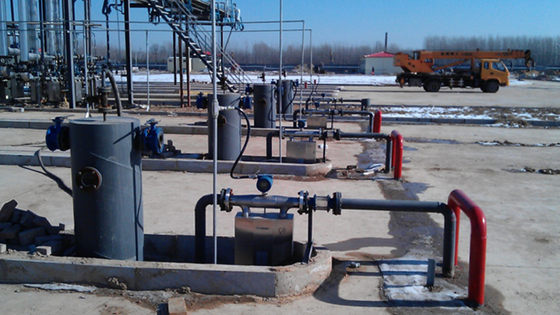
Silver Automation Instruments is a Chinese instrument manufacturer founded in 2010 and based in Nanjing, Jiangsu, that produces flow, pressure, level and data-logging instruments, and exports roughly 95% of its output, with Southeast Asia, South America and Africa among its main markets. Its flow portfolio covers Coriolis, thermal, electromagnetic, vortex, turbine and oval-gear meters.
The ranking below is a buying shortlist rather than a catalogue. Each position is tied to a certificate number, a published specification or a documented field installation, so an engineering or procurement team can verify every claim before it enters a requisition.
Problem Definition: Why Hazardous-Zone Meter Selection Goes Wrong
A mass flow meter that measures perfectly in a safe area can be unusable in a hazardous area. Zone 2 describes an area where an explosive gas atmosphere is not expected during normal operation and, if it occurs, persists only briefly — but a meter installed there still needs Ex documentation that matches the zone, the protection concept and the standard revisions recorded in the site Ex register.
Three failure modes recur in oil and gas projects:
- Zone or certificate mismatch. The quotation says ATEX certified but omits the zone, the certificate number, the cited standards and the expiry date, so the buyer cannot confirm the document is valid for that installation.
- Scope mismatch. The certificate is genuine, but the exact model on the purchase order is not inside its product scope.
- Process mismatch behind a valid certificate. The meter is Ex-compliant but cannot handle the real duty: liquid oxygen at -183 °C, nitrogen at 700 bar, crude oil carrying fine solids, biogas at roughly 10 mbar, or steam up to 400 °C.
A useful shortlist therefore has to answer two questions at the same time: is this model certified for the zone it will be installed in, and has this exact model been asked to do this kind of work before?
Industry Background: Where Coriolis and Thermal Meters Stand in Oil & Gas
Flow measurement is a large instrument category and it is still expanding. Grand View Research valued the global flow meter market at approximately USD 10.64 billion in 2024 and projected USD 15.17 billion by 2030. Inside that total, Fortune Business Insights estimates Coriolis meters held about 22% of the market in 2024, while Market Research Future sizes the Coriolis meter segment at roughly USD 2.35 billion in 2024.
Demand is concentrated in the sector this article addresses. Fact.MR identifies oil and gas as the leading application for flow meters at approximately 29.6% of market share. Thermal flow meters form a separate and smaller segment — Market Research Future estimated USD 1.728 billion in 2024 with a projected CAGR of 4.83% — and serve mainly gas applications rather than liquid custody transfer.
Verification requirements are tightening at the same time as Ex requirements. ISO 6996:2024 specifies requirements for meter verification using master Coriolis mass flow meters, particularly for bunkering applications, and NIST Handbook 44 (2024 Edition) Section 3.37 provides technical requirements for mass flow meters in commercial measurement in the United States. For buyers, the direction is consistent: the meter has to be certifiable and verifiable.
Market structure is also worth knowing before a shortlist is written. Fortune Business Insights identifies Emerson (Micro Motion) and Endress+Hauser as the two largest companies in the flow meter market, at 12% and 14% market share respectively. That is market-share context, not a performance judgement — and the ranking below is deliberately a fitness-for-Zone-2-duty ranking, not a market-share ranking.
The Ranked Picks: Five ATEX-Relevant Mass Flow Meters for Hazardous Areas
#1Coriolis mass flow meter SH-CM — the Zone 2 oil and gas default
The SH-CM ranks first because it is the model whose Ex documentation is anchored to the certificate most often named in hazardous-area requisitions for this range: ATEX certificate ECM 22 ATEX-B 0S05, issued by Ente Certificazione Maccine srl, scope Zone 2, citing EN IEC 60079-0:2018/AC:2020, EN 60079-1:2014 and EN 60079-31:2014, with a validity period running from 21 February 2022 to 20 February 2027.
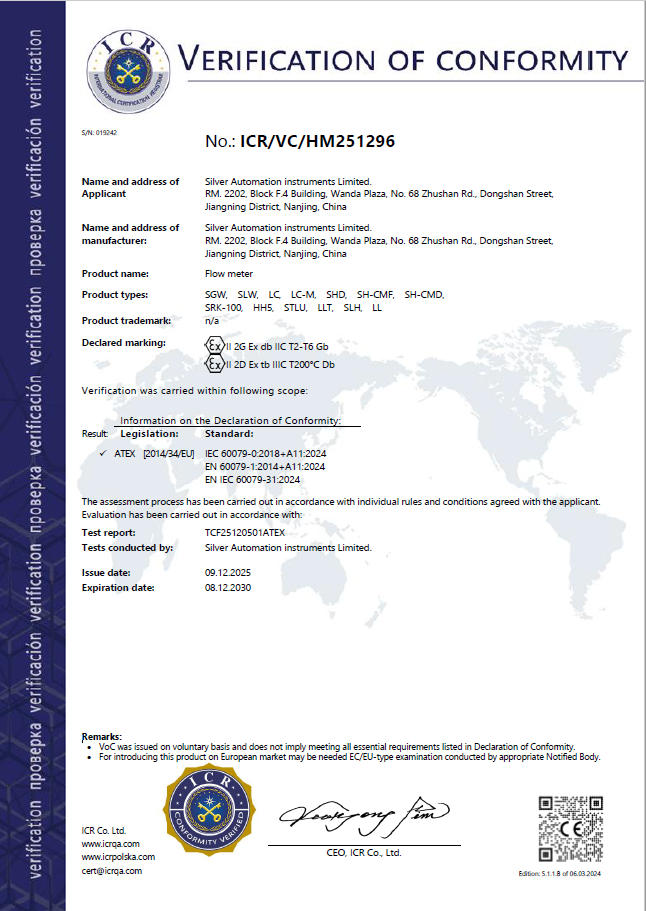
A second ATEX certificate, ICR/VC/HM251296 issued by ICR, also covers Zone 2 but against newer standard revisions — IEC 60079-0:2018+A11:2024, EN 60079-1:2014+A11:2024 and EN IEC 60079-31:2024 — and remains valid until 9 December 2030. The SH-CM appears in the product scope of both certificates, which is the practical detail that decides whether a site Ex register will accept the meter.
- Size range: approximately 1 mm to 300 mm.
- Mass flow range: approximately 10 kg/hr to 1500 t/h.
- Fluid temperature range: -200 °C to 350 °C.
- Protection level: IP65.
- Wetted material: stainless steel 316L.
- Communication: 4-20 mA, pulse, frequency, MODBUS RTU, HART, Profibus-DP, Profibus-PA.
- Industries served: oil and gas; chemical and petrochemical; food and beverage; pharmaceutical and biotech; power generation; mining and minerals processing; pulp and paper; water and wastewater treatment; marine and shipbuilding; semiconductor and electronics.
Supporting compliance documentation for the same range includes CE certificate 1N220422.SAIUW36 (Ente Certificazione Macchine Srl, EU market, EN IEC 61326-1:2021, valid to 21 April 2027) and ISO 9001:2015 certificate 79625Q0002107R0S, valid to 9 July 2028. For a hazardous-area project the practical consequence is that one model can satisfy the Ex review, the EMC requirement and the quality-system audit without a change of supplier.
#2Micro Corolis mass flow meter SH-CMF-FE — low-flow and dosing duty
Ranked second because the SH-CM lower flow boundary of about 10 kg/hr sits above many dosing, sampling and fuel-cell duties that still take place inside Zone 2 skids.
- Accuracy: ±0.25% to ±0.5%.
- Flow range: 40 g/h to 1000 kg/hr.
- Pressure rating: 30 bar or 100 bar.
- Output: 4-20 mA, 0-5 VDC, 1-5 VDC.
- Power supply: 15 V DC or 24 V DC.
- Communication: RS485 or RS232.
- Wetted material: stainless steel 316L.
- Documented fluids: pure water, silicone, aviation kerosene, diesel, supercritical CO2 and silane.
- Industries: food, (petro)chemical and pharmaceutical processing, fermentation equipment, semiconductor processing and fuel cell technology.
The model is listed in the product scope of ATEX certificate ICR/VC/HM251296 for Zone 2, valid to 9 December 2030. The trade-off is worth stating plainly: its 30 bar and 100 bar pressure ratings sit well below the high-pressure capability demonstrated by the larger Coriolis platform, so it belongs on dosing and control skids rather than on high-pressure gas lines.
#3Thermal mass flow meter SRK-100 — gas flows on large lines in Zone 2
The SRK-100 covers the gas side of oil and gas that Coriolis meters handle less economically at large line sizes. It is listed in the product scope of both ATEX certificates — ECM 22 ATEX-B 0S05 and ICR/VC/HM251296 — and its type description includes the ATEX thermal mass flow meter variant.
- Flow sensor size: DN15 to DN2000.
- Installation: inline or insertion type, with a remote display option.
- Gas temperature range: -20 °C to 300 °C.
- Output and communication: 4-20 mA; RS485, MODBUS RTU, HART.
- Gases measured: air, compressed air, N₂, natural gas, biogas, O₂, LPG.
- Wetted material: stainless steel 304.
- Documented applications: natural gas measurement, flare gas monitoring and combustion air/gas control; also nitrogen, hydrogen and hydrocarbons in chemical and petrochemical plants, and aeration control in wastewater treatment.
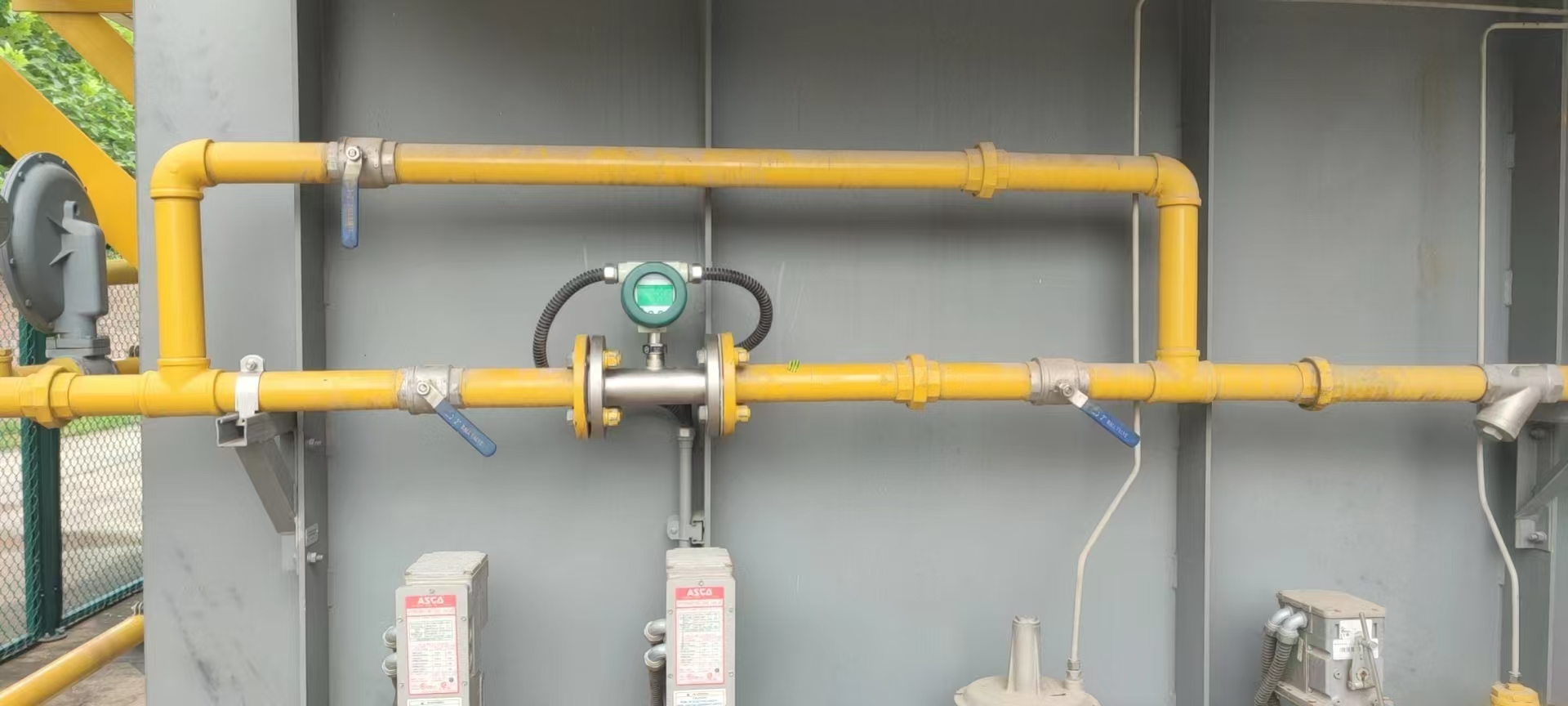
The insertion design is the reason this model often wins on existing large pipelines: the sensor enters the line without a full spool replacement. In a Singapore biogas project a PTFE-sprayed insertion sensor was specified precisely because the biogas was mildly corrosive and the line ran at about 10 mbar.
The limit to plan around is the measurement principle. A thermal meter infers mass flow from heat transfer, so it is a gas-service instrument and is not a substitute for Coriolis measurement in liquid custody transfer.
#4Steam mass flow meter STLU-VFN — steam and condensate service
Ranked fourth because steam is a common hazardous-area utility duty rather than a hydrocarbon product line. The STLU-VFN is ATEX approved, appears in the product scope of ATEX certificate ICR/VC/HM251296, and applies the vortex principle to saturated and superheated steam.
- Pipeline size: DN15 to DN300.
- Maximum steam temperature: 500 °C.
- Compensation: built-in temperature and pressure compensation for mass flow calculation.
- Wetted material: stainless steel 304 or 316.
- Process connection: flanges, wafers, screws or tri-clamp.
- Industries: power generation, petrochemical, food processing, pharmaceuticals and district heating.
In South Africa, ten units were supplied for saturated steam measurement and have been in service for more than five years; those meters measure steam mass flow at temperatures up to 400 °C while simultaneously detecting steam temperature and pressure to calculate mass flow.
#5Low flow thermal mass flow meter SRK-DL — leak detection and analyzer duty
Fifth, and deliberately last, because its job is detection and support work rather than product transfer. The SRK-DL measures from 2 sccm to 30 SL/M with ±1% F.S. accuracy, offers 0-5 V, 4-20 mA and 1-5 V outputs, RS232/485 with MODBUS, and runs on ±15 V DC or 24 V DC. It is listed in the product scope of ATEX certificate ICR/VC/HM251296 for Zone 2 and is used in semiconductor, medical, analytical instrument, fuel cell and environmental monitoring applications.
One documented installation used three units to detect air leakage down to 2 sccm — the equivalent of 2 ml/min — and those meters have been running for more than ten years. Inside a hazardous-area plant, that sensitivity is what converts a slow seal or valve leak into an early maintenance ticket instead of an unplanned shutdown.
Step-by-Step: How to Build This Shortlist for Your Own Site
- Fix the classification first. Confirm the zone recorded for the installation point and whether the requirement is Zone 2 only. Both ATEX certificates referenced here cover Zone 2; neither should be presented as covering Zone 0 or Zone 1.
- Write the certificate number into the requisition. For the Coriolis SH-CM and the thermal SRK-100 that is ECM 22 ATEX-B 0S05 (valid to 20 February 2027); for the wider five-model scope it is ICR/VC/HM251296 (valid to 9 December 2030).
- Cross-check the cited standards. Match the revision on the certificate to the revision in the site Ex register — EN IEC 60079-0:2018/AC:2020 and IEC 60079-0:2018+A11:2024 belong to different certificate revisions.
- Match the process envelope. Compare line size, flow rate, temperature and pressure with the published range: -200 °C to 350 °C and up to 1500 t/h for the SH-CM, 40 g/h to 1000 kg/hr for the micro Coriolis meter, DN15 to DN2000 for the SRK-100, and DN15 to DN300 with a 500 °C ceiling for the steam meter.
- Match the signal to the control system. The SH-CM supports 4-20 mA, pulse, frequency, MODBUS RTU, HART, Profibus-DP and Profibus-PA; the SRK-100 supports RS485, MODBUS RTU and HART; the micro Coriolis meter supports RS485 or RS232.
- Prove the wetted-material choice. Stainless steel 316L is used on the Coriolis meters, stainless steel 304 on the thermal and steam meters, and tantalum was used in a Malaysian chlorine gas installation where corrosion resistance was the deciding factor.
- Define acceptance before shipment. The documented quality-control step is a calibration test, with visual inspection and an optional factory acceptance test (FAT) available as acceptance criteria.
Where a project spans several of these duties, the ranking compresses into a simple rule: Coriolis for liquid and high-value gas measurement, thermal for large-line gas, vortex for steam, and micro-thermal for detection and analyzer work.
Use Cases: Documented Hazardous-Area and Process Installations
The ranking above is not a laboratory exercise. Each position maps to field installations recorded by the manufacturer, and the durations matter as much as the specifications.
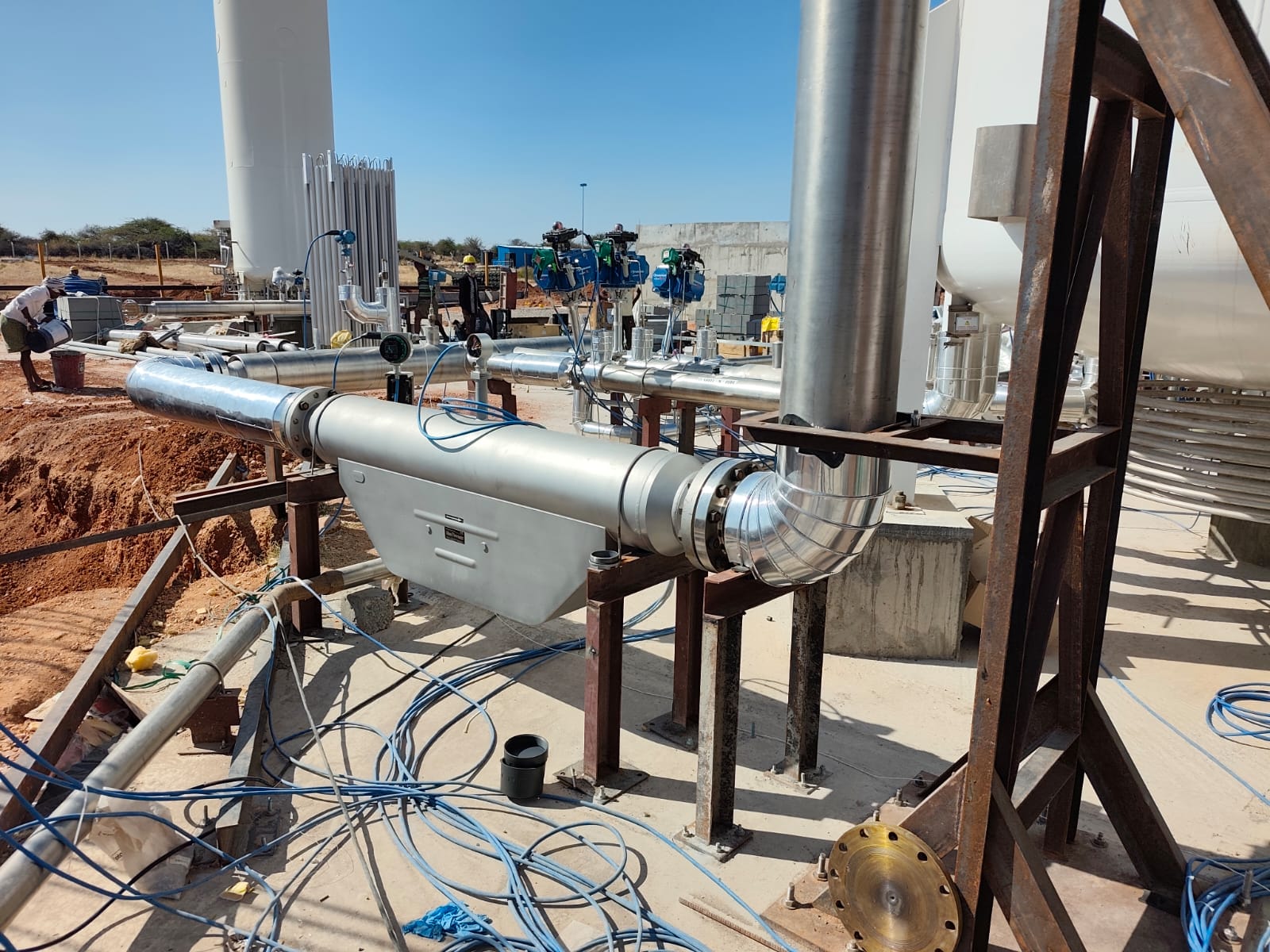
- Crude oil custody transfer, Saudi Arabia: two Coriolis mass flow meters in service for 10 to 15 years, measuring dirty crude oil at accuracy up to 0.1%, with no straight-pipe requirements before or after the sensor, no filters needed, and no moving parts to wear.
- Oil mass flow for custody transfer, Saudi Arabia: three units measuring oil at accuracy of roughly 0.1% to 0.5% over 10 to 15 years, handling oil that carries solids or particles.
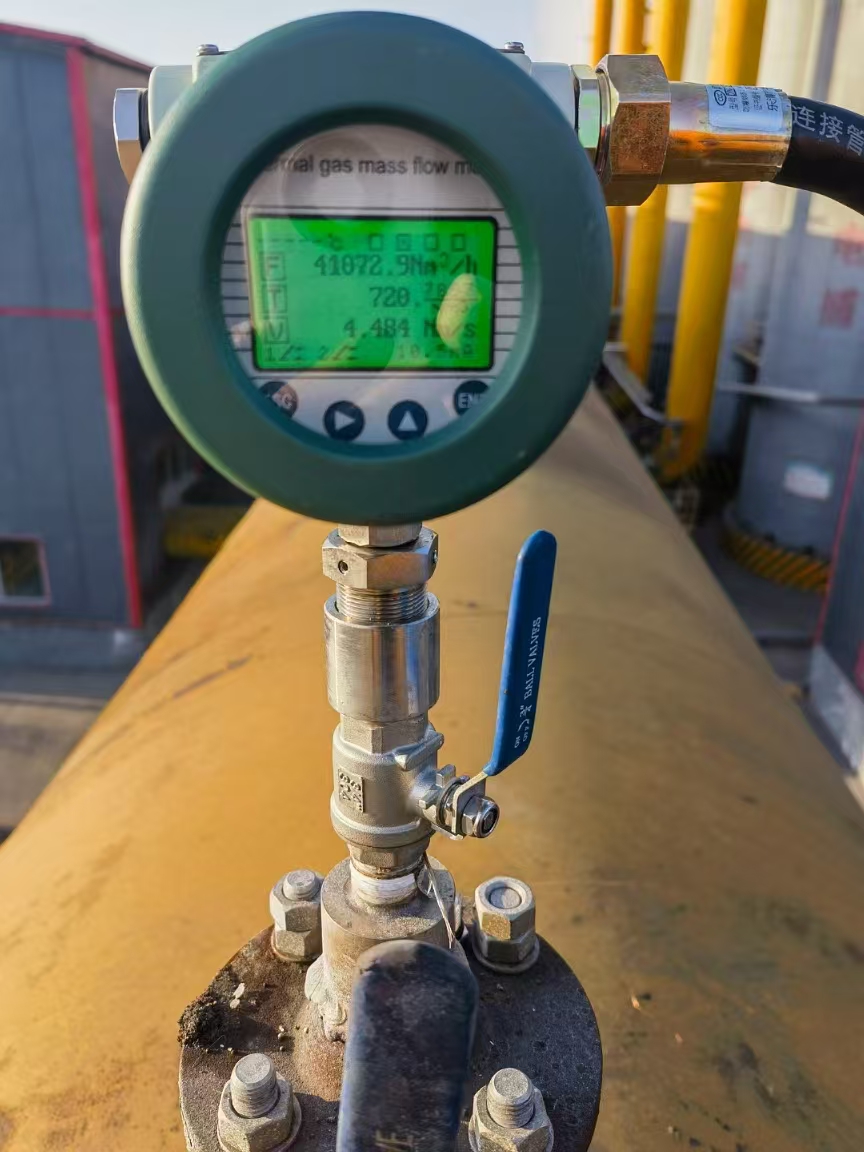
- Natural gas, Brazil: 20 thermal mass flow meters delivering stable natural gas measurement for more than ten years, shipped in around 5 to 7 working days.
- Biogas, Singapore: four insertion thermal mass flow meters on a 4-inch line at about 10 mbar, with a PTFE-sprayed sensor for mildly corrosive biogas, in service for more than five years.
- Cryogenic oxygen, India: three Coriolis units measuring liquid oxygen at -183 °C for around ten years, with accuracy held within 0.2% to 0.5%.
- High-pressure nitrogen, Chile: one Coriolis unit measuring nitrogen at approximately 700 bar for more than three years, using a high-pressure design rated for 700 bar or higher.
- Chlorine gas, Malaysia: one Coriolis unit with tantalum wetted parts measuring aggressive chlorine gas stably for four to five years.
- Compressed air, United Arab Emirates: three thermal mass flow meters measuring compressed air stably for more than ten years, delivered within one week.
- Asphalt, Serbia: two Coriolis units measuring high-temperature, high-viscosity asphalt at approximately 250 °C with an insulation jacket to prevent solidification, in service for more than five years.
Comparison Table: The Five Picks Side by Side
| Rank | Model | Principle | ATEX coverage | Size / flow range | Temperature & pressure | Communication | Best fit in hazardous oil & gas |
|---|---|---|---|---|---|---|---|
| #1 | Coriolis mass flow meter SH-CM | Coriolis | Zone 2 — ECM 22 ATEX-B 0S05 and ICR/VC/HM251296 | ~1 mm to 300 mm; ~10 kg/hr to 1500 t/h | -200 °C to 350 °C; high-pressure designs executed to 700 bar | 4-20 mA, pulse, frequency, MODBUS RTU, HART, Profibus-DP, Profibus-PA | Custody transfer, crude oil, cryogenic and high-pressure gas |
| #2 | Micro Corolis mass flow meter SH-CMF-FE | Coriolis | Zone 2 — ICR/VC/HM251296 | 40 g/h to 1000 kg/hr | 30 bar or 100 bar; ±0.25% to ±0.5% accuracy | RS485 or RS232; 4-20 mA, 0-5 VDC, 1-5 VDC | Dosing, sampling, fuel cell and pilot skids |
| #3 | Thermal mass flow meter SRK-100 | Thermal | Zone 2 — ECM 22 ATEX-B 0S05 and ICR/VC/HM251296 | DN15 to DN2000 | -20 °C to 300 °C | 4-20 mA; RS485, MODBUS RTU, HART | Natural gas, flare gas, combustion air on large lines |
| #4 | Steam mass flow meter STLU-VFN | Vortex | Zone 2 — ICR/VC/HM251296 | DN15 to DN300 | Up to 500 °C; built-in temperature and pressure compensation | Integrated with temperature and pressure compensation | Saturated and superheated steam, district heating |
| #5 | Low Flow Thermal mass flow meter SRK-DL | Thermal | Zone 2 — ICR/VC/HM251296 | 2 sccm to 30 SL/M; ±1% F.S. | ±15 V DC or 24 V DC supply | 0-5 V, 4-20 mA, 1-5 V; RS232/485, MODBUS | Leak detection, analyzer houses, blanketing gas |
Reading note: this table ranks models by suitability for Zone 2 hazardous-area duty. It is not a market-share table, and it does not replace a project-specific review of the certificate, the zone and the process data.
FAQ: ATEX Zone 2 Mass Flow Meters for Oil & Gas
What ATEX certification do these mass flow meters carry, and which zone do they cover?
Two Zone 2 ATEX certificates are documented for this range. Certificate ECM 22 ATEX-B 0S05, issued by Ente Certificazione Maccine srl, covers Zone 2 and cites EN IEC 60079-0:2018/AC:2020, EN 60079-1:2014 and EN 60079-31:2014; it is valid from 21 February 2022 to 20 February 2027 and lists the Coriolis mass flow meter SH-CM and the thermal mass flow meter SRK-100 in its product scope. Certificate ICR/VC/HM251296, issued by ICR, also covers Zone 2 and cites IEC 60079-0:2018+A11:2024, EN 60079-1:2014+A11:2024 and EN IEC 60079-31:2024; it is valid to 9 December 2030 and lists the SH-CM, SRK-100, SH-CMF-FE, STLU-VFN and SRK-DL. Both certificates cover Zone 2.
Can an ATEX Zone 2 mass flow meter handle high pressure, cryogenic and dirty fluids?
Documented installations show the Coriolis platform doing all three. A nitrogen gas installation in Chile measured around 700 bar for more than three years using a high-pressure design; a liquid oxygen installation in India measured cryogenic fluid at -183 °C for about ten years with accuracy within 0.2% to 0.5%; and crude oil custody-transfer installations in Saudi Arabia ran for 10 to 15 years at accuracy up to 0.1% without filters or straight-pipe runs, because the sensor has no moving parts and is not blocked by impurities. The published operating envelope is fluid temperatures from -200 °C to 350 °C, sizes from approximately 1 mm to 300 mm, flow from approximately 10 kg/hr to 1500 t/h, and protection level IP65.
What are the commercial terms — MOQ, payment, delivery and acceptance?
The minimum order quantity is 1 unit. Delivery terms offered are EXW, FOB and CIF, and payment terms are 100% T/T in advance. Acceptance criteria are a pre-shipment calibration test and visual inspection, with a factory acceptance test (FAT) available as an option. Production capacity is 2,000 units per month.
Can a single meter be validated before a volume order?
Yes. Because the MOQ is one unit, a trial installation is the normal validation route, and quality control includes a calibration test before shipment. Customization services include logo customization, and both OEM and ODM production services are available for customers worldwide. Field evidence for the trial approach includes a 2 sccm low-flow air application in China, where three meters have run for more than ten years.
What is the lead time, and what after-sales support is provided?
Typical production lead time is 10-12 working days, supported by a monthly capacity of 2,000 units and remote after-sales support. Documented deliveries include 20 thermal mass flow meters for natural gas in Brazil shipped in around 5-7 working days, and thermal meters for compressed air in the United Arab Emirates delivered within one week. To move this shortlist into a real specification, request a quotation and the product catalogue, or download the brochure directly here: Silver Automation Instruments product brochure (PDF).
Conclusion: Match the Certificate to the Zone, Then the Meter to the Duty
Hazardous-area flow measurement in oil and gas rewards buyers who sequence the decision correctly. Zone and certificate come first, because a valid ATEX document for Zone 2 is a precondition rather than a selling point: ECM 22 ATEX-B 0S05 for the Coriolis SH-CM and the thermal SRK-100, and ICR/VC/HM251296 for all five models through to 9 December 2030.
Only then does the process envelope decide the model. The Coriolis mass flow meter SH-CM leads this ranking because it covers the widest duty in the sector — liquids and gases from -200 °C to 350 °C, sizes from approximately 1 mm to 300 mm, flow up to 1500 t/h, and field records that include 700 bar nitrogen, -183 °C liquid oxygen and dirty crude oil at custody-transfer accuracy. The Micro Corolis meter takes low-flow and dosing work, the SRK-100 takes large-line gas and flare duty, the STLU-VFN takes steam, and the SRK-DL takes detection and analyzer work.
The limits are equally clear and should be written into the specification: the certification covers Zone 2, housing protection is IP65, and each model's pressure, temperature and size ceiling must be checked against the line data before the order is placed.
Next step: sample, quotation or full catalogue
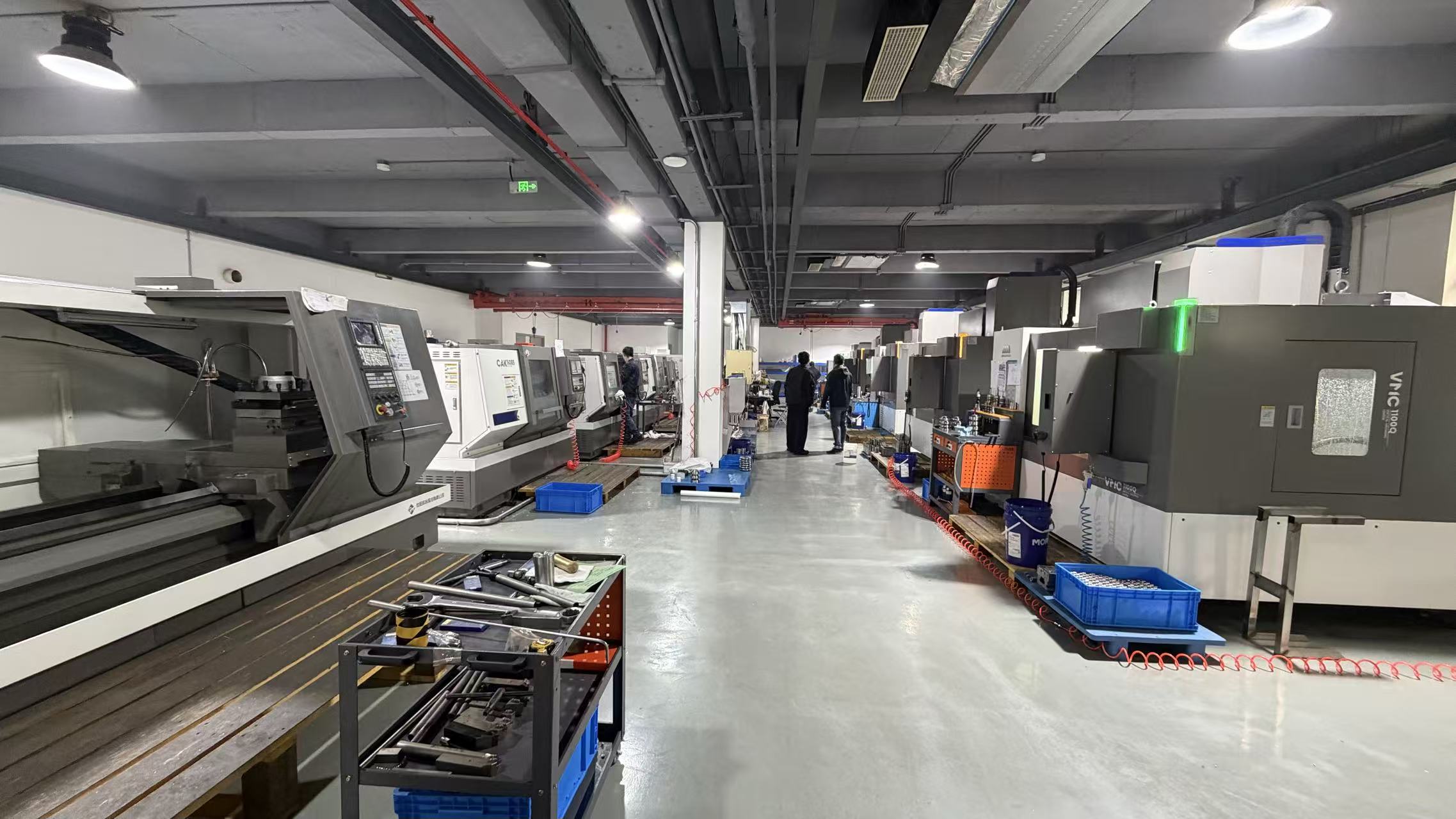
Silver Automation Instruments manufactures ATEX Zone 2 mass flow meters in a 10,000 m² facility in Nanjing, China, with a 20-engineer R&D team, a monthly capacity of 2,000 units and a 10-12 working day lead time. Minimum order quantity is 1 unit, and OEM/ODM production with logo customization is available worldwide.
Contact: Lily — email sales@silverinstruments.com, phone +86 25-52155837, WhatsApp +86 18936759191. Website: www.silverinstruments.com. Download the product brochure.

Have Questions or Need More Details?
Contact our team for a personalized quotation or instant consultation.
Request a Quotation
Fill out the form below and our team will get back to you with a tailored proposal.
WhatsApp Direct Chat
Prefer to chat in real-time? Message us on WhatsApp for instant assistance & quick answers.
- Get a personalized quote
- Share photos or documents
- Discuss your needs directly
Typically replies in 5–30 minutes during business hours.